Reflective Dog Harness Manufacturer: How to Select a Reliable Factory
Selecting a reflective dog harness manufacturer comes down to four verifiable capabilities: control of the reflective material source, a stitched or woven attachment rather than bonded film, wash-cycle retroreflection testing, and a named substrate under any metal coating. A factory that can evidence all four is a different class of supplier from one that can only produce a sample.
A reflective dog harness manufacturer should be judged on material traceability and post-wash performance rather than on how bright the sample looks under a phone flash. This category is unusual because its defining attribute is invisible in daylight and degrades silently with every wash, which means buyer inspection cannot substitute for supplier documentation. A trim that photographs brilliantly in a dark room may already be at half its original return.
The audit below follows the material rather than the product: where retroreflection comes from, why attachment outlasts material grade, the one test most suppliers cannot run, the four questions that separate a tested product from a sample, and how measurement should be recorded. It closes with the harness checks that reflective trim tends to disturb, and with the documentation that actually supports a claim.
Where Reflective Performance Actually Comes From
Retroreflection returns light toward its source, while diffuse brightness scatters it in every direction, and that distinction explains why a white trim can look brighter to a bystander and still perform worse for a driver. Glass-bead tape uses microscopic spheres behind a binder and drapes well on curved harness surfaces, handling flexing without cracking, but its return falls off as the observation angle widens. Microprismatic sheeting uses moulded cube-corner geometry and holds return across a wider angle, at the cost of stiffness and sensitivity to surface abrasion.
Neither option is universally better, and the decision belongs to the geometry of the product rather than to a datasheet. A highly efficient sheeting that cracks at the shoulder turn is a worse choice than a moderately efficient tape that stays intact through a season. Buyers who compare only peak brightness are choosing the number that is easiest to print and hardest to notice in use.
| Material | Strength | Failure risk |
|---|---|---|
| Glass-bead tape | Flexible, good wash tolerance | Weaker at wide observation angles |
| Microprismatic sheeting | Strong return at wide angles | Cracks or lifts on tight radii |
| Reflective yarn | Woven in, cannot delaminate | Lower peak brightness |
| Bonded film | Lowest cost, easy to apply | Delaminates in washing |
Attachment Method Outlasts Material Choice
A mid-grade tape sewn in place will outperform a premium tape bonded with adhesive, because adhesive on flexible webbing faces repeated bending on the same line, shear along the strap and hot wash cycles. Failure begins at a corner and spreads along an edge, ending as a flap that catches on everything. The material was not defective; the interface was.
Stitched attachment spreads those stresses through the thread line, and the specification that matters is stitch type, stitch density and whether the seam runs inside the reflective field or along its border. Stitching along the border preserves the full reflective area and is the more common production choice, while stitching through the surface reduces effective area on glass-bead tape unless needle and thread are chosen carefully. Woven-in yarn removes the interface entirely: peak brightness is lower, but there is no layer to separate, and this is a capability most tape applicators simply do not have.
The Test Most Suppliers Cannot Run
Ask two questions in sequence. First, whether the factory measures retroreflection and with what instrument. Second, whether it measures after washing and for how many cycles. The first question filters out assemblers, because a retroreflectometer only makes economic sense if you develop reflective products rather than buy trim by the roll. The second filters out factories that test incoming material but never test the assembled product.
Degradation that matters happens after assembly, wear and laundering, so wash testing should follow a defined method. AATCC 61 and ISO 105 cover colourfastness to laundering and use the same cycles that reveal reflective loss, and whatever protocol is used needs a documented procedure with a stated pass criterion. A supplier who cannot name the standard, the cycle count and the acceptance value is describing an impression rather than a test.
Four Audit Questions Worth Asking Directly
Four questions cover the whole material claim: who manufactures the reflective material and can you name the grade, is the trim stitched, woven in or bonded, what is the measured retroreflection before and after five wash cycles, and which method was used with who witnessed the test. Ask them in one meeting and watch who answers without leaving the room.
A supplier who answers all four has a tested product. A supplier who defers three of them is selling a sample, and the deferral usually continues after the order. That behaviour is the strongest signal available in this category, because the underlying capability cannot be improvised late.
How a Reflective Dog Harness Manufacturer Measures Retroreflection
A reflective dog harness manufacturer should measure retroreflection with a retroreflectometer at two observation angles, before and after a defined wash cycle, and record the values per lot. Observation angle matters because a driver approaches at an angle rather than head-on, so a single on-axis reading describes the best case rather than the walking case. Entrance angle matters as well, since the harness sits on a curved body and each band presents a different surface angle to the light source, which is why readings taken on a flat coupon overstate what the product can do.
Record the reading after the third and fifth wash rather than only at dispatch, because reflective loss is gradual and the curve between those points predicts how the product looks three months in. Storage and handling affect the material before it ever reaches a harness: dust, oil from hands and ultraviolet exposure all reduce return, and a roll stored against a sunny window can lose performance before cutting begins. Trim width interacts with angle as well, since a narrow band returns light across a smaller area but can be read at a sharper angle than a wide flat band, and a qualified material from one source is not interchangeable with an equivalent grade from another because binder chemistry differs.
Check the Harness While You Check the Trim
Reflective performance gets the attention, but the product still has to behave as a harness. Verify the closure substrate, the stitch pattern at load points and the webbing finish at the contact band in the same visit, because those three decide whether the product survives the season the trim was designed for.
Pay specific attention to how reflective trim interacts with adjustment hardware. Trim adds thickness, and thicker material running through a slider changes holding force, so a pattern that received reflective trim without a slider re-test will creep. Placement logic matters too: two narrow bands at different heights outperform one wide band, because a single band can be occluded by posture or leash angle.
Documentation That Supports the Product
OEKO-TEX Standard 100 covers skin-contact safety on dyed fabric, and ASTM D4966 abrasion data indicates how a surface withstands rubbing, which matters because abrasion is one route to reflective loss. ASTM B117 salt-spray data covers metal hardware, and the substrate should be identifiable as AISI 304 or 316 wherever stainless is claimed.
For market access, REACH SVHC and RoHS cover Europe and Prop 65 covers California. None of these documents is a reflective-performance standard, and no supplier should imply otherwise, because a compliance pack that is presented as proof of visibility is the most common misreading in this category.
The EASY LOCK Position
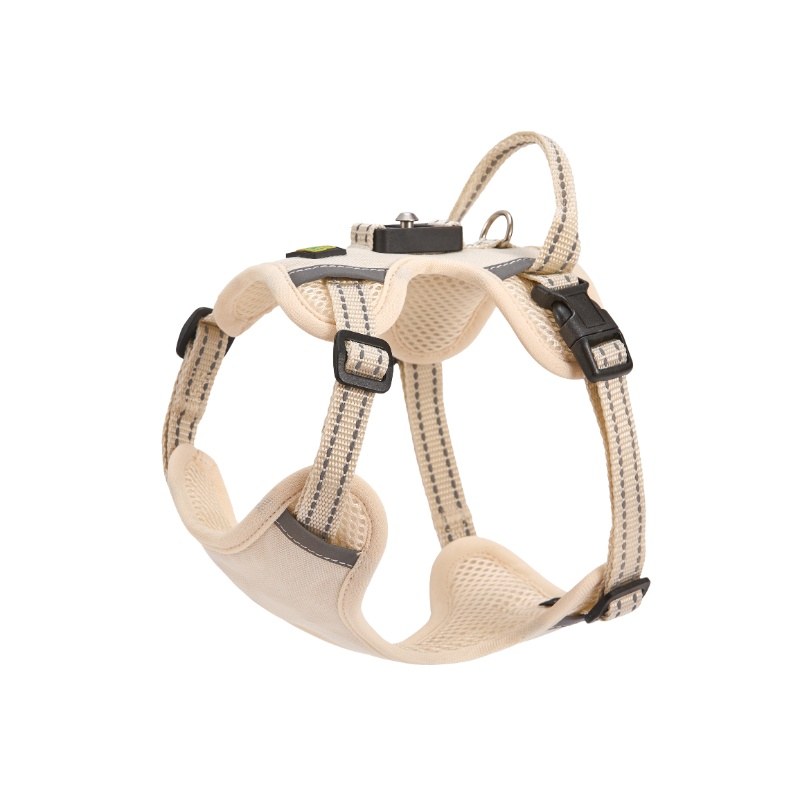
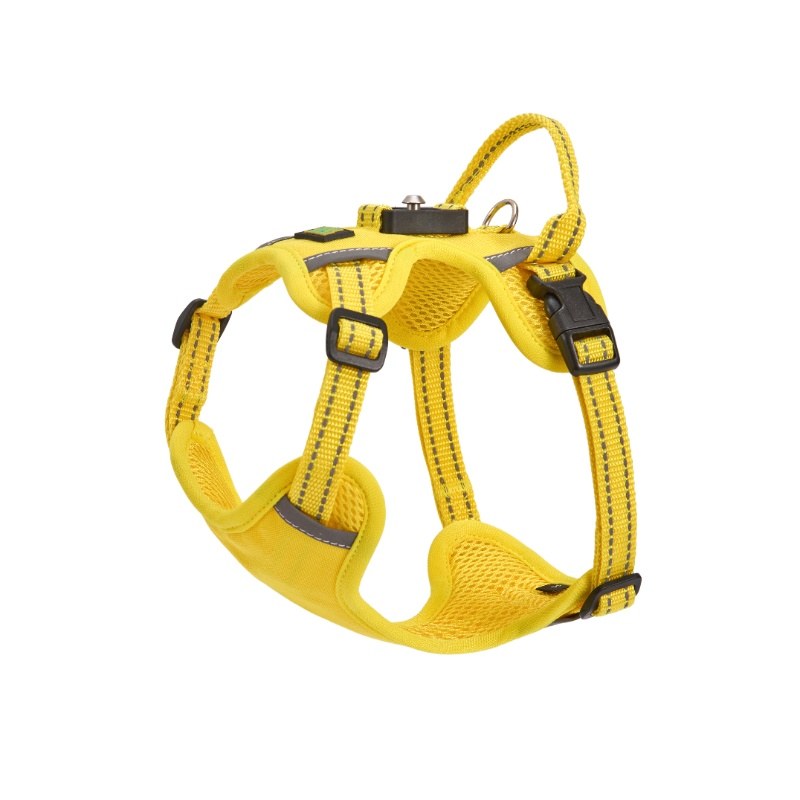
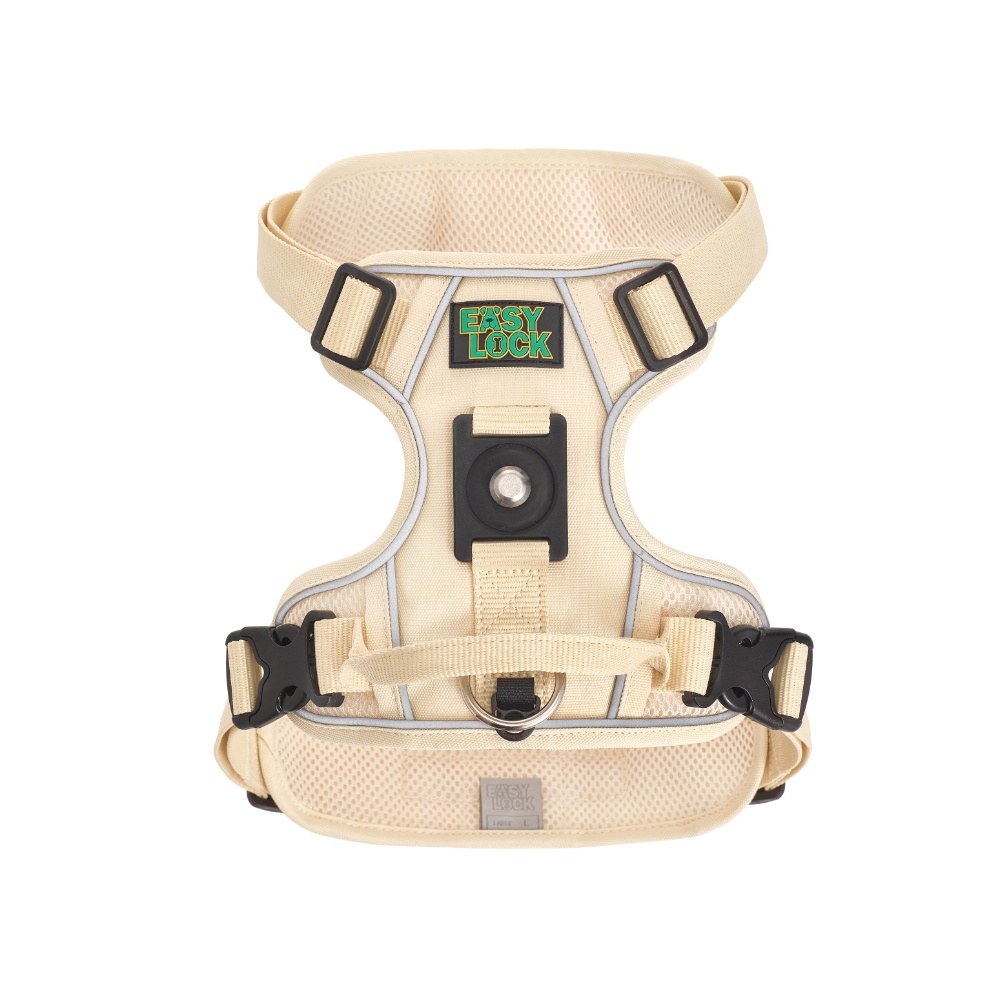
EASY LOCK was founded in 2018 on more than 15 years of webbing manufacturing experience, and we weave, finish and assemble in one facility. Reflective elements can be integrated at the weaving stage rather than applied afterwards, which removes the adhesive interface entirely. Our harness platform comes from a three-year development cycle with more than 100 rounds of material testing and is protected by national patents including the Mag-Clip single-touch release, with sizes running XS to XL on consistent hardware.
Construction is shown on the dog harness range page, and fabric work is described on the harness fabric page. Read together, they show where the reflective element enters the strap rather than being applied to it afterwards.
Frequently Asked Questions
Q1: Is brighter reflective trim always better?
No. Peak brightness at a narrow angle is not the same as visibility at the angles a driver approaches from. Angular coverage and durability usually matter more.
Q2: How many washes should reflective trim survive?
Define the number against the care label and test to it. What matters commercially is that the number is documented and repeatable, not that it matches a competitor's claim.
Q3: Can reflective trim be added to an existing pattern?
Yes, but it is a modification rather than an accessory. Added thickness changes slider behaviour and added stitching changes the load path at anchors.
Q4: What should the price premium be based on?
Material grade, attachment method and testing depth. A wide strip of bonded film costs less to produce than a narrow woven-in band and performs worse over the product's life.
Final Thoughts
A reliable reflective dog harness manufacturer can name its material grade, describe its attachment method and show wash-cycle data rather than wash-cycle claims. Those three answers cannot be improvised, which is why the audit is worth running before a sample is even requested. Test the trim after washing, confirm the slider still holds, and background on our operation is on the company page, including how a reflective dog harness is built from the yarn up.
Ask for the Wash Data, Not the Sample
Tell us your market and care instructions. We will send reflective construction options, test references and a placement proposal for your range.
Request Reflective Test Data