Adjustable Dog Harness Design: Key Features That Improve Comfort and Fit
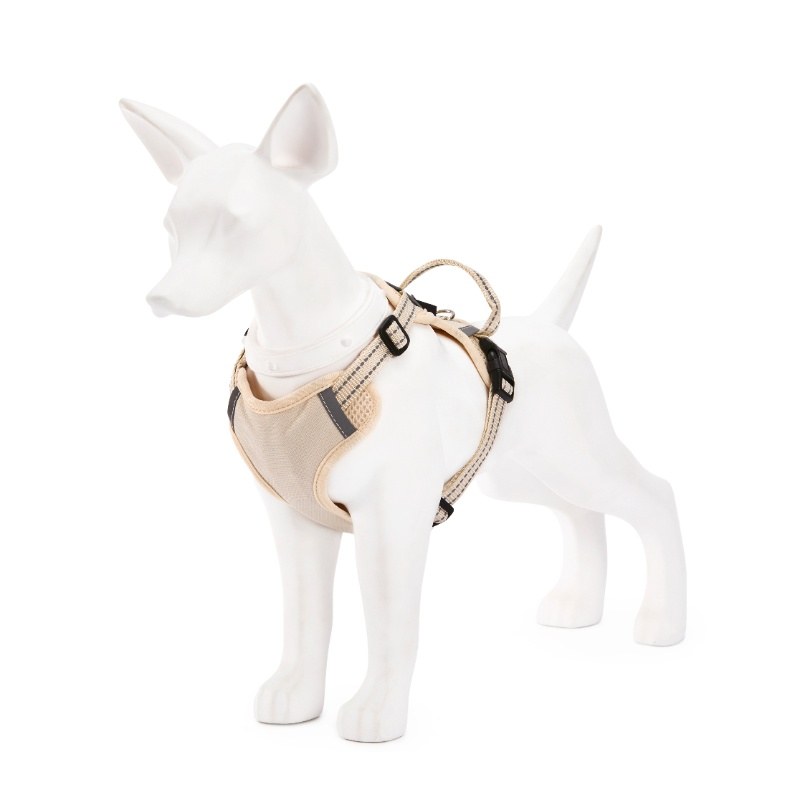
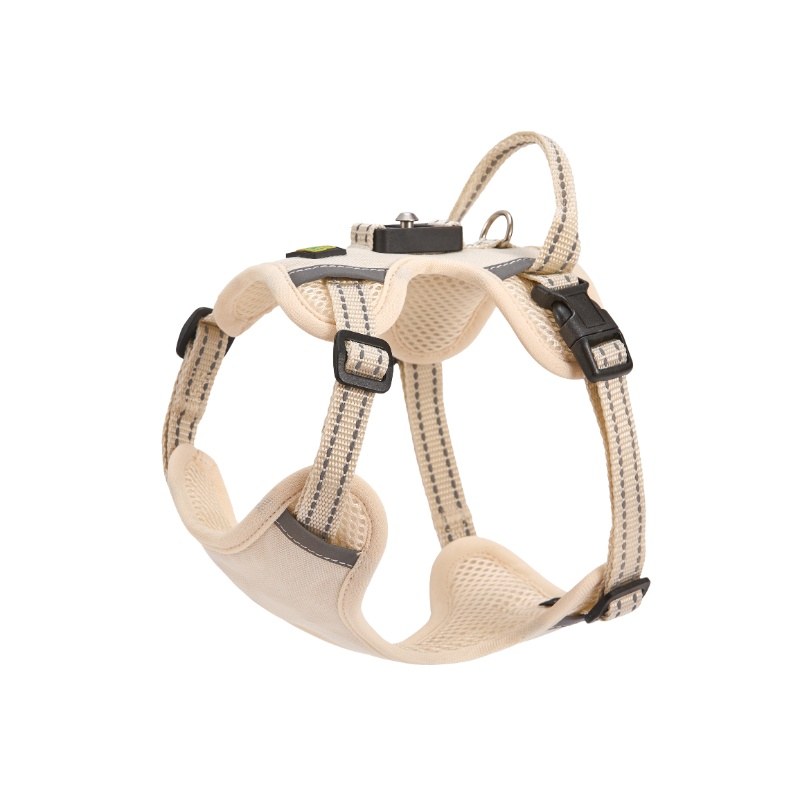
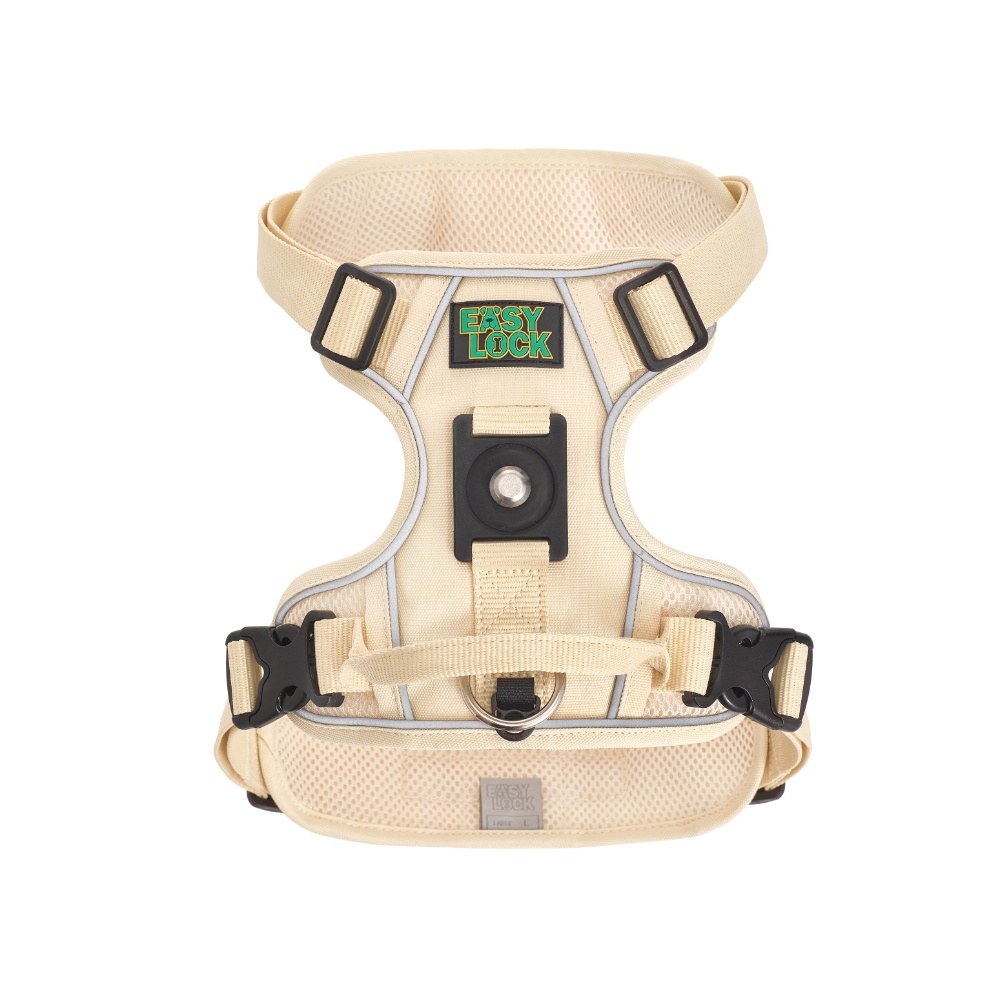
Adjustable dog harness design is decided by three geometric zones, one adjustment range and one contact band. Fit is a geometry outcome, not a padding outcome. Specify those four things correctly and the visual programme can be whatever the brand needs.
Good adjustable dog harness design rests on three zones: a neck opening that clears the shoulder without gaping, a chest panel that returns to centreline under load, and a girth band positioned by leg geometry rather than by tightness. Everything else — padding, trim, hardware finish — is secondary to those three, because they decide whether the harness is still comfortable after ten minutes of trotting. That is the only test a customer actually performs.
This article works through the geometry zone by zone, then the adjustment range, the load path created by a front ring, the contact surfaces and the four small details that decide daily usability. It closes with the fit tests worth running before a pattern is approved, and with what the product should still do after fifty washes.
Zone One: The Neck Opening and Shoulder Clearance
The neck opening is not a circle. It sits over the withers and slopes toward the chest, with the shoulder blade rotating underneath it on every stride, which is why a simple ring-shaped opening fails in one of two ways: too far back and it restricts shoulder rotation, too far forward and it drifts toward the throat. Neither problem is visible on a standing dog in a photograph, and both become obvious the moment the dog trots.
The design fix is an asymmetric opening, high over the withers and lower and wider on the throat side, with an adjustment slider positioned so the opening can clear the head without loosening the chest strap. That last detail is small and decisive. A harness that requires the owner to loosen the chest strap to get it on will never be re-adjusted correctly, and an incorrectly adjusted harness fits worse than a cheap one that was set once and left alone.
Zone Two: Chest Panel Centreline Under Load
The chest panel carries load when the dog pulls, so its centreline has to stay under the sternum, and two design choices control that: the angle at which the front straps meet the panel, and whether the panel is anchored at one point or two. A single-anchor panel is cheaper and rotates under asymmetric load, while a two-anchor panel stays square at the cost of more stitch work at the junction.
A practical check settles the question in seconds: pull the D-ring sideways and release it. A well-built panel returns to centre on its own, while a weak one stays where it was pulled, and that offset becomes a rub point on the next walk. Panels that fail this check usually pass a static fit inspection, because the failure only appears when the dog turns its head against the leash.
Zone Three: The Girth Band Behind the Front Legs
The girth band is the highest-motion, highest-friction area on the product, and position relative to the leg matters more than tightness. Too close to the armpit produces chafe regardless of fabric softness, while too far back makes the band slide forward as the dog moves, so deep-chested and barrel-chested dogs need different placements from the same nominal size. This is where a single pattern stretched across a size range stops working.
Padding is often used to compensate for bad placement, and it helps at low pressure while hurting at high pressure, because it adds bulk exactly where the leg swings. The correct sequence is placement first, then the minimum padding that contact pressure requires. Reversing it hides the problem in the sample and reveals it in the field, where the customer has no way to tell whether the discomfort is a design fault or their own fitting error.
Adjustment Range: More Travel Is Not More Fit
A wider adjustment range does not make a size more forgiving, and treating it that way creates three problems that are easy to miss at the sample stage. Long travel leaves excess strap tail that has to be retained or it flaps, it changes the front-strap angle at the extremes and therefore the load distribution, and it widens size overlap until a retailer cannot explain which size a customer should buy.
The design target is a range that covers natural variation within a size band and overlaps the next band by roughly one step, validated at both ends rather than at the centre. One question exposes most range problems: at maximum extension, does the D-ring stay centred and does the girth band stay behind the shoulder? If either answer changes between settings, the harness has two fits and only one of them was tested.
Load Distribution and the Front-Ring Question
The leash attachment point determines behaviour under pull. A back ring keeps load over the shoulders and suits general walking, while a front ring redirects forward motion sideways, which is why it appears in no-pull designs. A front ring also loads the chest panel asymmetrically, and that asymmetry has to be designed for rather than absorbed, because the loads do not cancel out.
Three things must be settled before a front ring is added: reinforcement behind the ring, the angle of the strap carrying the redirected load, and the stitch pattern at the junction. Adding a front ring to a back-ring pattern is a common shortcut and a predictable failure, with the panel tearing at the anchor in the same place across every unit in the lot. For lighter walking programmes, the lightweight harness construction shows how much structure can be removed before load distribution suffers.
Contact Surfaces: Pressure, Friction and Edge Stiffness
Comfort is a pressure-and-friction problem rather than a softness problem, and fabric hand-feel is the least predictive variable in the set. Width spreads pressure, which is why large-breed harnesses use wider webbing, but width also adds stiffness at the shoulder turn, so it has to be matched to geometry rather than maximised. A wide strap on a tight shoulder radius creates a hard edge pressed into the skin, which is worse than a narrower strap on a well-placed band.
Lower friction reduces shear at the girth band, which is where an anti-chafe finish earns its cost, and edge stiffness matters most behind the front legs, where a hard heat-cut selvedge will abrade even on a perfectly placed band. Textile validation supports all three claims: OEKO-TEX Standard 100 for skin-contact safety, AATCC 61 or ISO 105 for colourfastness through washing, and ASTM D4966 Martindale data for abrasion. Together they predict whether the softness in the sample survives a season of real use.
Four Details That Decide Daily Usability
Four small features separate a harness that works from one that merely fits, and none of them appear on a specification sheet unless someone deliberately adds them. Strap tail retention comes first: after adjustment the loose end needs a keeper loop or a tuck, because without one it flaps, catches on branches and gets chewed. D-ring clearance is the second, since the ring needs enough room for a leash clip to move without binding against the panel, and a tight ring wears the clip gate while irritating the owner on every walk.
Label placement is third: a care label sewn into a contact zone will chafe, so it belongs outside the girth band or inside a folded seam. Reflective placement is fourth, because trim on a curved surface is only visible from certain angles, and two bands at different heights outperform one wide band. Stitched-in yarn also outperforms glued film after washing, which matters in a category where the product is washed regularly.
Fit Tests to Run Before Approving the Design
Five tests cover the commercial risk, and four of them can be run without laboratory equipment. Static fit at both adjustment extremes confirms the size works at the edges, gait observation reveals shoulder restriction and band migration, and a trot-and-turn session shows whether the panel returns to centreline under asymmetric load. A wash-and-refit check exposes dimensional drift and slider grip loss, while an owner trial with people who are not dog professionals reveals the one-handed donning problems that staff members unconsciously work around.
| Test | Reveals | Pass condition |
|---|---|---|
| Fit at min and max | Size that only works mid-range | D-ring centred at both ends |
| Gait observation | Shoulder restriction, band creep | No stride shortening, no forward migration |
| Trot and turn | Panel rotation under asymmetric load | Panel self-centres |
| Wash and refit | Dimensional drift, slider grip | Same fit position after three washes |
| Owner trial | One-handed donning | Fits without loosening the chest strap |
How an Adjustable Dog Harness Should Behave After Fifty Washes
An adjustable dog harness should return to the same fit position after fifty washes, with no more than the stated dimensional tolerance and no measurable loss of slider grip. Three properties drive that outcome: webbing shrinkage control, edge stability and slider spring retention. Shrinkage changes strap length, edge stability changes how the strap seats in the slider, and spring retention changes holding force.
Post-wash dimension is the value to specify rather than greige width, because webbing measured before dyeing and finishing says very little about the strap that reaches the customer. A supplier who quotes greige width has quoted the wrong number, and the mistake only surfaces after the first customer wash.
The EASY LOCK Position
EASY LOCK was founded in 2018 on more than 15 years of webbing manufacturing experience, and we produce the webbing, closure and assembly in one facility. A finish change at the girth contact band can therefore be made to the same dimensional tolerance rather than sourced from the nearest available strap. Our harness platform comes from a three-year development cycle with more than 100 rounds of material testing and is protected by national patents including the Mag-Clip single-touch release, with sizes running XS to XL on consistent hardware.
Construction references across the range are on the dog harness collection page, and walking scenarios that change the design brief are covered in our application notes. Both are worth reading before a pattern review, because the brief usually shifts once the walking scenario has a name.
Frequently Asked Questions
Q1: Is more padding always more comfortable?
No. Padding helps where pressure is concentrated and hurts where the leg swings. Fix placement and width first, then add the minimum padding the contact pressure requires.
Q2: Should an adjustable dog harness have a front ring?
Only when the panel and stitch pattern are designed for redirected load. Adding one to a back-ring pattern produces anchor failure at the junction, usually across every unit in the lot.
Q3: How many adjustment points are practical?
Four: neck, chest and two body straps. Fewer limits fit across breed shapes, while more adds hardware, weight and owner confusion without improving fit materially.
Q4: What is the most common design defect in samples?
A neck opening that works when held open but drags on the ears when donned, because the chest strap has to be loosened to get it on. It is a pattern fix rather than a production fix.
Final Thoughts
Adjustable dog harness design rewards discipline more than creativity. Settle the neck opening, the panel centreline and the girth position, define an adjustment range with a one-step overlap, validate at both extremes, then repeat the fit after washing. To discuss a specific construction, use our company page, where the pattern and production approach behind an adjustable dog harness is set out in more detail.
Put Your Pattern Through a Fit Review
Send the pattern or a reference product. We will check the three fit zones, the adjustment range and the load path before tooling starts.
Book a Fit and Pattern Review